Hints on how A.E. Graves spends her imaginary spare time
Author: aegoncoffee
Human female. Multi-racial, mostly vegan foodie. Science-lover. Photographer, both alt-process wet darkroom AND digital. Fluent in legalese. Use a French press with enthusiasm. Bibliophile. Cephalopodaphile. Taught swimming, trained as an architect, teach users on legal software and legal/compliance topics.
Krista Vernoff tweeted out a list of crimes she personally committed in her youth on Twitter, and how, in EVERY INSTANCE, she was escorted home, chided gently, and given a bottomless series of chances to change her life.
She knows that black people don’t receive these bottomless chances, and asks other white folks to reflect on this, and to change the system. Because: IT NEEDS TO CHANGE.
She wrote the tweets up into a piece for the Washington Post, and I’m sharing because it is worth a read:
When I was 15, I was chased through a shopping mall by police while a store owner shouted, “Stop, thief!” I had thousands of dollars of stolen merchandise on me. I made it to the parking lot and hid between the cars before I was caught, booked, tried, sentenced to six months of probation, and required to see a parole officer weekly.
It is fantastic to read this as a first-person perspective: that may be enough to inspire others who were forgiven for their youthful “mistakes” to act on behalf of others who have not been so fortunate.
Folks were once afraid that the Internet on phones would end reading, but it feels like that’s ALL I do with my phone now…
Here’s an overview of reading activities this week, whether or not I’ve written about it elsewhere here:
Books: -Lucy Corin’s One Hundred Apocalypses and Other Apocalypses (which I won’t write a review of – disoriented narrators aren’t my thing) -T Cooper’s Real Man Adventures (which kept me up WAAAAAY past my bedtime last night, giggling and being quite moved) -Cory Doctorow’s Information Doesn’t Want to Be Free: Laws for the Internet Age -Terry Smith’s Whitelash: Unmasking White Grievance at the Ballot Box
Web: –Guardian UK (paid supporter) (for coronavirus, Black Lives Matter, and some world news) –Johns Hopkins University & Medical Center Coronavirus Resources (for coronavirus data) -Twitter (heavily: I follow lots of writers and journalists, and they have a LOT to say right now, especially about BLM, Americans living in denial of coronavirus, and disinformation – reading on the Supreme Court is a big focus) –US Supreme Court Decision in Bostock v. Clayton County (OH MY GODS – and yes, I have an annotated PDF version with my notes, to help me digest it) -Washington Post (paid subscriber) (BLM, coronavirus, world news, and politics) -Wikipedia (donor)(very random things)
SARS-CoV-2: I would spend even more time reading about the pandemic, but I am lucky enough to work at a future pharmaceutical company, and receive presentations BY DOCTORS AND PHDs who are on our staff about the mechanisms of disease, what they are learning through their professional organizations, and how this relates to their specialties. It’s AMAZING stuff, and I can’t pretend I understand all of it, but I get something valuable from each session.
SUPREME COURT: That decision in Bostock kept me up VERY late: while the decision is 30 pages long, the dissents are 140 pages long (what a ratio), and after the ladies at Rewire said in their podcast that the dissents were “spicy”, I HAD TO KNOW DIRECTLY. And once I began, I just didn’t stop. 170 pages of decision TAKES TIME, it turns out, especially if you are fanatically highlighting your copy. The decision was full of surprises (Gorsuch!?!? GORSUCH!?!?); a friend who doesn’t work in law marveled that he could understand it; the dissents were not of equal quality (Alito seemed pretty worked up, and his attempt to distinguish anti-miscegenation cases from this turned weird pretty fast; his use of labels was interesting/revealing…); a gay friend DID want the law to distinguish between sex, sexual orientation, and gender identity in this particular decision (which is something for new laws to address if that is what we want – the terminology has changed so much in my lifetime, that it is no surprise to me that the laws haven’t kept up) … I came away feeling like the decision was even stronger for trans rights than for gay rights, because the court has strong view of male and female, and becoming one or the other should be within their grasp as fully covered by a law hung up on those distinctions… but this pretends that the court accepts all trans people as their new sex (like I do), which they don’t.
Yes, I am a Supreme Court geek, and used to post especially great quotes from Supreme Court decisions on my office door at the law firm. Yes, most of those quotes were from Justice Ginsburg. I love RBG’s writing – love love love it. (Yes, the RBG Movie is worth watching – it is SO EXCITING that people understand the court, and care about how it works!)
(No, I haven’t read the DACA opinion yet, just many, many interpretations of it, but I am eager to read it myself…)
This has probably happened to you: you are trying to look up the date or location of some famous-but-ordinary event, only to find yourself still online, many hours later, learning about the knot-based recording system of ancient people of the Andes. The links of the Internet are catnip for the curious, and this can lead not only to unintended hours of indirect research online, but also some conversational derailments.
Curiosity can cause social problems, trust me on this. My Cousin forgave me immediately, however.
I will now briefly map how a conversation with my Cousin went from (a) focusing on the charm of some family photos relating to an ancestry research project to (b) the Japanese internment in the USA in just five topical steps due to interconnected links in the wonderful site known as Wikipedia.
MAP: My grandfather’s appearance as a light-skinned black man > his nickname Red > other Black people with the nickname Red, such as Malcom X ,who was a dishwasher with shared nickname holder Redd Foxx > Redd Foxx > Red Foxx’s friend (Noriyuki) Pat Morita (yes, Mr. Miyagi in Karate Kid), who appeared on Redd’s popular show Sanford and Son with a TERRIBLE joke name > Pat Morita’s internment with his familyat Gila River Internment Campafter his release from the hospital where he was recovering from surgeries for spinal TB.
(Yes, I would have continued if I hadn’t then realized I’d sucked all the charm out of the topic of my grandfather’s photo. OOOPS.)
Seriously, though, Pat Morita had a rough childhood. Imagine being paralyzed most of your youth, and when you finally get out of the hospital after years of painful surgeries and recovery, you are sent to join your family… in an internment camp.
Aside: Wikipedia is a great project, and you should consider sending some money to the Wikimedia Foundation (donate.wikimedia.org).
Information Doesn’t Want to Be Free: Laws for the Internet Age by Cory Doctorow published by McSweeney’s, San Francisco 2014
Before I discuss the book, I’d like to say that there was NO WAY Doctorow could have predicted the current coronavirus pandemic, and so the advice early in the book about how you shouldn’t be making a living off recordings of your performances, but should really be touring and making money on live shows was well intentioned. There is more on offer, so don’t stop at that point!
Cory Doctorow’s book extols the virtues of the unregulated distribution system known as the Internet, and advises that we should LET GO of the idea of having our creations protected by copyright and adapt.
His views are practical, but I rolled my eyes a few times while reading a physical copy of his book, which was professionally edited, published by a real publisher, and printed on paper by a printing company that got paid. Full disclosure: my bias here is that I LOVE HIS PUBLISHER, I have been buying things they publish for years, and I WANT THEM TO EXIST. Their existence requires some concessions to the models of business which he is critiquing.
He isn’t saying that traditional content publishing & distribution businesses are BAD for all purposes (except in a few places), he is saying that there are more options now, and we have the Internet to thank for that. And that is true, and is good. This is the core and highlight of the book’s themes.
The catch is that digitized creative work has been deeply devalued, and many people just take what they want without paying creators. Doctorow warns creators that making a living isn’t easy regardless (honest and a fair, gentle warning!), and then paints a sunny picture of the tech environment – if people love you, they’ll find ways of getting money to you, and you should make that easy for them to do!
He devotes lots of page space to the futility of preventing unauthorized copying. I’d feel better about it if I didn’t think my friends were getting ripped off. (I am NOT happy that some dude in Germany was burning CDs of a friend’s band’s new album and selling the CDs to pocket the money himself. That is not cool – my friend and his band had to spend a lot of time/effort/music-love/money to record that album. How many fans who want to support him are getting their money diverted away to this random dude?) I get that we are living in a sort of take-what-you-want age, and I personally mock friends who ‘rip’ content they can easily afford to buy. They are NOT supporting creators. Excuses about not wanting to support the corporate players in the industry ring hollow: these pals don’t need the stuff, but they are taking it anyway (like consuming dessert, but refusing to pay for it because the cafe is part of a corporate chain). Industries employ people and can be useful in promoting and distributing creative work – a writer whose indie publisher failed to promote him insisted that a corporate marketing department REALLY IS a useful service, and he wished he had access to one.
The arguments structured as: – I can’t do what some of the big corporate tools do by myself – I insist on using big web corp’s tools for my own purposes – so this creates obligations on big web corp to fulfill more of my needs, rather than the needs of their paying business customers, and restrictions on me on this corporate tool are oppression….I just don’t see it. I preferred the old argument about how, if you didn’t like a tool, you could build a better one. (I’m an OLD geek.) If we aren’t willing to build a tool, the situation we find ourselves in is: someone else’s house, someone else’s rules. I believe we should regulate the hell out of public resources to ensure they are democratic and access is universally provided for the public benefit; we should let corporate-funded platforms serve corporate purposes – even if they build a big membership which we wish was more publicly accessible. If a popular corporate platform has many users, it does not automatically become a public utility – there has to be some trade off for that to be fair.
This is a thoughtful book, which draws different conclusions than I draw about what corporate stuff is useful for, but which has some fine asides about licensing revenue for content creators. I admire Doctorow’s optimism about technology, and his desire for things to be better for creators.
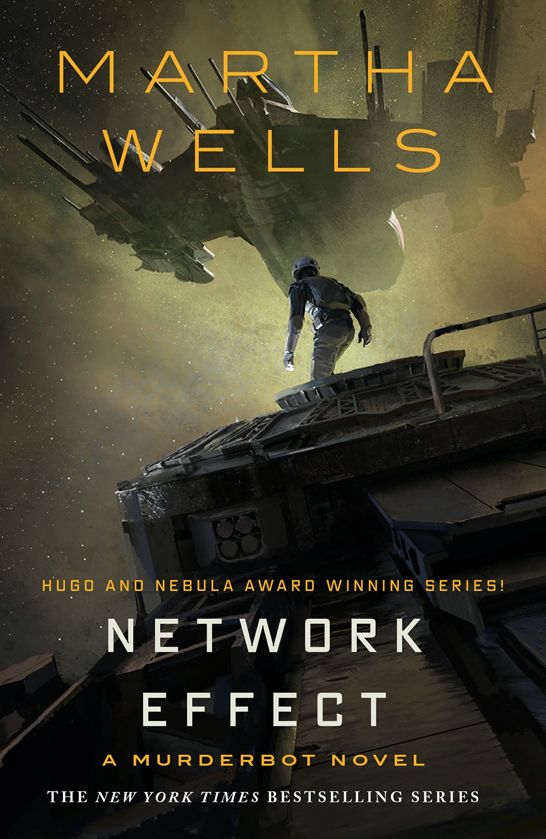
Network Effect: A Murderbot Novel by Martha Wells published by Tor 2020
Yes, Martha Wells has published the fifth book in the Murderbot Diaries, and she hit the word count to be a full-length novel while doing so, which is a big WIN for all of us Murderbot fans! More Murderbot to love!
First: if you haven’t read all four of the novellas, you really must do so: not only because they are awesome, but because they are part of one story, and you need to read those to understand the characters and events that appear here.
Okay: the novel is fantastic. It is fun! It combines the heavy action, emotional angst, sincere affection for certain humans, profane internal monologue, gender-neutral grammar, and inter-robot-friendship you have come to know and love. Adventure! Drama! Alien artifacts! Wells’ writing continues to be delightful, concise, and fantastic. The greater page length delivers more of the same joy the novellas did, in the same style.
This book made my day. Murderbot fans can rejoice in this novel, and look forward to more.
I have been a lifelong fan of “the mail.” I send and receive heaps of mail, and handwritten letters were my primary way of staying close to friends and relatives who are many hours away by plane. I’ve also have/had fantastic pen friends, with whom I’ve had friendships spanning more than 30 years.
I love sending heartfelt messages, and I love receiving them; the same with friendly notes.
Now that my grandparents (who were VERY dedicated correspondents) are gone, I’ve looked to other friends for the satisfaction of good mail. I have a couple fantastic, active pen pals. I also have some well-intentioned friends who thought they would make good pen friends. Despite their excellent intentions, and the way they wax poetic about the idea of written correspondence, they do not DO it. I’ve spent years encouraging them, but the effort has been one- sided: I write to them regularly, they thank me via text or phone for all the notes, but they don’t write back: it isn’t really important to them.
The solution to this is to only write letters to people who also writeletters. Shocking, I know! 😀
My main source of postal joy and positivity in the past few years is Postcrossing. This project run by two fun people in Portugal, is a brilliant database/club. You sign up, get five addresses, and send them postcards. (Postcards are MUCH easier for people to finish than letters!) Once your postcards reach their destinations, the recipients register their arrival; your address is then given to a participant so they can send you a card; plus, you can request another address to send to. This is FAIR: you only get a card when you have successfully sent a card. (Intentions are irrelevant!) Gradually, as more of your cards reach recipients, you are allowed to send more. You control the pace, as you get to choose when to request another address.
A postcard exchange project that invites everyone to send and receive postcards from random places in the world. For free!
I joined in early 2017, and have sent and received more than 700 postcards. I now have quite a lovely collection of them, and go out of my way to keep a good supply on a wide range of subjects for sending. It doesn’t take long, and it is FUN! I highly recommend it for mail lovers who want to both send AND receive mail; people who enjoy surprises; people who want to have an excuse to buy more postcards; and people who like to encourage random strangers far away.
P.S. Having a new card collection helped me let go of my last, tiny crumbs of resentment about a friend who unwittingly destroyed my postcard collection from friends in college. It was taped to the wall, and I asked for help to gather them while moving out. Rather than removing the tape (which he had watched me do), he stuck them all together, so each was taped with strong adhesive to the face of the next one. It was unsalvageable (even with steam, even with time), and the images AND notes from friends and loved ones had to get tossed out. So: fresh start!
P.P.S. Those friends I got as pen pals in 1984 from the International Pen Pal organization were GREAT – I met three of them, and am still dear friends with one of them (and saw her again last fall). I believe this link leads to their successor organization:
Have you ever considered that the greatest friend you may ever have could be someone you have never met, living in a country you have never visited? International Pen Friends has over 300.000 members in 192 countries and we can provide you with new friends in your own age group from most countries around the world.
P.P.P.S. No, Letter Writers Alliance has ended as a project. I have one great pen pal from them (whom I’ve met!), and would recommend them if they were still active!
I am some combination of tired and emotionally vulnerable, because I surprised myself by really liking the Google Juneteenth video doodle. I mean, what are the odds?
Speaking of the San Francisco Museum of Craft and Design (sfmcd.org), they have a virtual exhibit on the theme of designs to create distance or separation to prevent the spread of the coronavirus SARS-CoV-2. Yes, creative people are already trying to work out how to make the world work during a time of highly contagious ailments, and they are raising interesting questions and proposing some pretty (and wild, and uncomfortable, and practical, and edgy) solutions. Some of these are intended as humor or commentary more than as design, but they round out the range of speculative thinking nicely.
June 2-December 31, 2020 Design by Distance showcases how designers from around the world are responding to the COVID-19 pandemic through the development of objects, garments, accessories, and space planning. Curated by Ginger Gregg Duggan and Judith Hoos Fox of c2-curatorsquared, Design by Distance highlights
There is a lot to think about here.
I like these cone-of-silence-like barriers for dining in groups:
Christophe Gernigon plex’eat, 2020 Stating that all the solutions he’d seen to date to insure safe dining had looked to him like prisons, French designer Christophe Gernigon created what he thinks of as a kind of a bell, an elegant form made from bent plexi, sized and configured to prevent claustrophobia, and to avoid interfering with pendant lamps, ubiquitous in dining spaces.
As an introvert, I also like these beach cubicles. While my enjoyment of them conceptually feels anti-social (which is supposed to be a bad thing in ordinary times), these DO appeal. I want to be outside! I want other people to keep their distance! These cubicles could help achieve this in crowded / popular locations, to a point.
Umberto Menasci SafeBeach, 2020 Lexan Perhaps his early legal training instigated Umberto Menasci’s current project, SafeBeach, enabling sun worshipers to enjoy beaches while respecting the new practices regarding social distancing. A grid of outdoor rooms, open to the sky, made of Lexan, allows for two lounge chairs, and one large umbrella, and a small table in each unit.
Afterward: We are in the adaptive phase of the SARS-CoV-2 pandemic, now that we have realized there is no immediate solution and we will need to change how we live. I’ll be remarking on other things like this, but at some point, once we HAVE adaptated, these environments will seem normal, and future people will look back on this and wonder why I made a fuss over THESE, rather than all of the shared/high-contact/crowded places of the past…
Why just wear a paper mask or bandana to protect your community from the spread of COVID-19 when you can get creative? The San Francisco Museum of Craft and Design sponsored a protective face mask competition: the winners are at the top, but the gallery with all of the entries is FUN, so I recommend that.
On May 11, the Museum of Craft and Design launched Let’s Face It, an international mask design competition. We received 363 entries from 17 countries, with participants ranging from 4 years old and up. Thank you to everyone who participated.
Loving Day is an annual celebration held on June 12, the anniversary of the 1967 United States Supreme Court decision Loving v. Virginia which struck down all anti-miscegenation laws remaining in sixteen U.S. states. In the United States, anti-miscegenation laws were U.S.
From the Wikipedia Article, above:
My generation was bitterly divided over something that should have been so clear and right. The majority believed that what the judge said, that it was God’s plan to keep people apart, and that government should discriminate against people in love. But I have lived long enough now to see big changes. The older generation’s fears and prejudices have given way, and today’s young people realize that if someone loves someone they have a right to marry.
Surrounded as I am now by wonderful children and grandchildren, not a day goes by that I don’t think of Richard and our love, our right to marry, and how much it meant to me to have that freedom to marry the person precious to me, even if others thought he was the “wrong kind of person” for me to marry. I believe all Americans, no matter their race, no matter their sex, no matter their sexual orientation, should have that same freedom to marry. Government has no business imposing some people’s religious beliefs over others. Especially if it denies people’s civil rights.
I am still not a political person, but I am proud that Richard’s and my name is on a court case that can help reinforce the love, the commitment, the fairness, and the family that so many people, black or white, young or old, gay or straight seek in life. I support the freedom to marry for all. That’s what Loving, and loving, are all about.
-Mildred Loving, June 2007, on the 40th anniversary of the Supreme Court’s decision in Loving v. Virginia